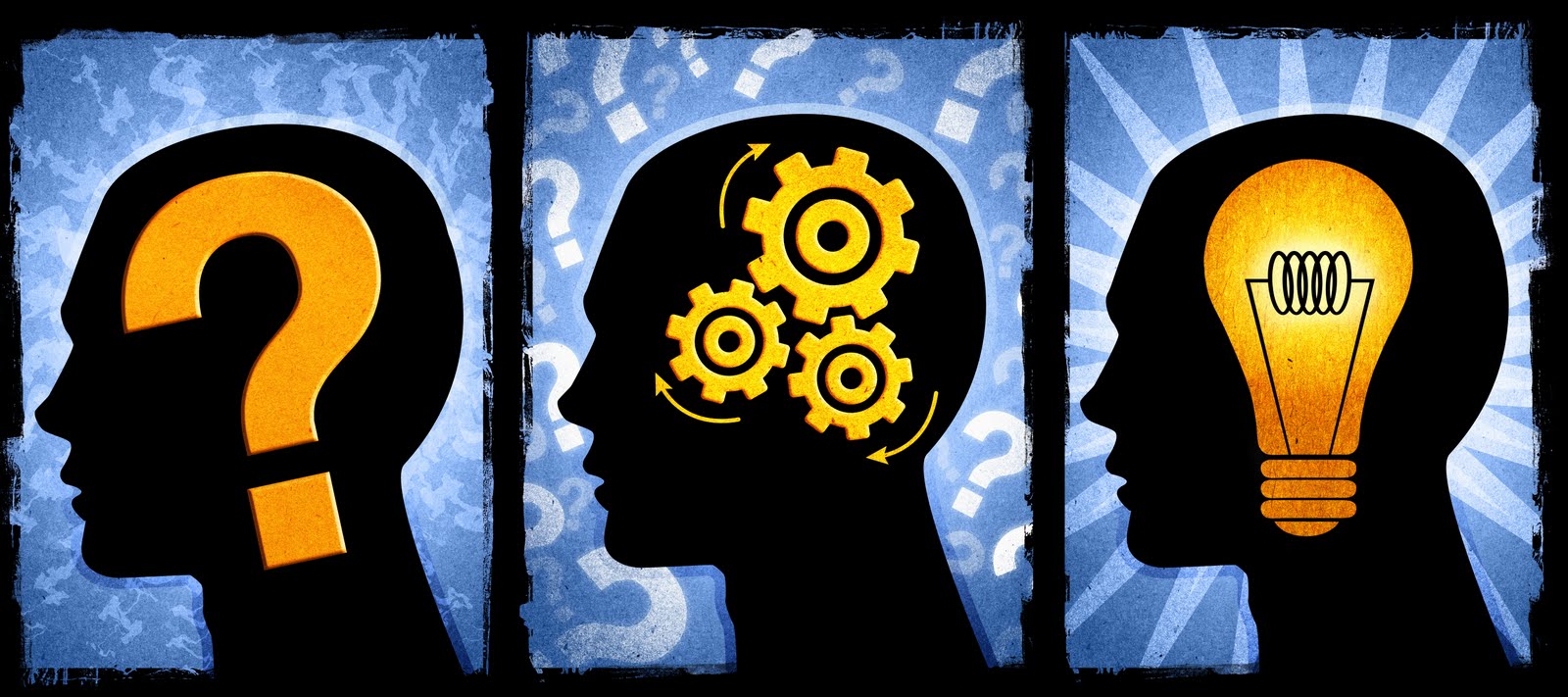
"Some things have to be believed to be seen."
That quote has been variously attributed to Ralph Hodgson, Madeline L'Engle and Abraham Lincoln. Maybe they all said it, it's not that original. In fact, it's the basis of almost everything we do on a daily basis.
Going back to the conversation about Thomas and how the evidence helped him to believe, we have to assume that it was his belief that helped him to see the evidence. There were many other people who saw Jesus resurrected and decided that it wasn't him.
But let's come back to that.
In 1982 an Australian scientist named Barry Marshall developed the hypothesis that stomach ulcers were caused, not by stress and spicy food, but by a bacterium. The scientific community ignored him, ridiculed him, and flat-out wouldn't believe him. The conventional wisdom was that stomach acid was too harsh an environment for bacteria to live in. Marshall persisted, but no one would believe him until, at his wits' end, he drank down a petri dish of the suspect bacteria. Within a few days he developed the ulcer.
This was proof that his hypothesis was right. It was in 1985.
Yet for decades the public and the scientific community alike persisted in believing that stress and spicy food caused ulcers. Finally, in 2005, Marshall's work was recognized and he was awarded the Nobel Prize in medicine.
It was only because he believed in his hypothesis that he saw a bacterium as the cause of ulcers instead of stress. Everyone else in the scientific community saw the same evidence yet believed something different. In the end, Marshall was shown to be right, but proof wasn't enough to convince the world. His unyielding belief was an indispensable part of the process.
Evidence can't exist without belief. Or rather, I should say that evidence isn't perceived as such without belief. It might be a bacterium, a sub-atomic particle, karma, or the resurrection of Jesus, whatever it is, unless you want to believe it, any evidence can be dismissed. And, if you're predisposed to believe it, anything can be construed as evidence.
That puts us in this dangerous middle-ground where we can't have any epistemic certainty. That is, we can't know for sure that we know anything. Since what we believe informs what we do with evidence and what we do with evidence informs what we believe, there's no beginning nor end to the cycle. Descartes' Archimedian point is quicksand. It's the chicken and the egg.
The basis of belief, then, is the certainty that we cannot have any certainty. Once we accept that everything we perceive is filtered through the lens of our belief, then we can start figuring out how good our beliefs are and how good our evidence is.
What have you seen because you believed in it?
Showing posts with label science. Show all posts
Monday, February 25, 2013
Tuesday, April 26, 2011
The Science of Belief and Unbelief
![]() |
| Fotolia© Jeff Metzger |
Imagine walking into work with the crowning achievement of your career under your arm. You are nearly trembling with excitement to share what you've been working on all night. Then the moment arrives and you get to share what you've discovered. You tell your bosses that the world is, in fact, round.
You're met with blank stares and a barely audible grunt. One of them asks how you got to this preposterous notion and you begin to describe your reasoning. Before long you've been shouted down and called a heretic. Not quite the day you were imagining. Something similar to this happens all the time. Evidence is ignored, skewed and reinterpreted based on the emotional bias of the people who hear it.
In the article, Mooney says: "Given the power of our prior beliefs to skew how we respond to new information, one thing is becoming clear: If you want someone to accept new evidence, make sure to present it to them in a context that doesn't trigger a defensive, emotional reaction."
If we're trying to lead people into a new way of thinking - a new way of believing. We can't start with contradicting what they've always thought. That's the road to increased resistance and intransigence. However, if we work to see the world from the perspective of the people we're trying to convince then we can present new information within the framework that they will expect. We are subversive
How do you work to change minds?
Labels:
chris mooney,
fotolia,
mother jones,
science,
unbelief
Monday, August 02, 2010
Audience Connection Leads to Brain Sync
Wired.com highlighted a recent brain science experiment that tracked the connection between listeners and speakers. "Brain scans of a speaker and listener showed their neural activity synchronizing during storytelling. The stronger their reported connection, the closer the coupling." They used fMRI (functional magnetic resonance imaging) to track the blood flow in the brains of the speakers and listeners during The Princeton researchers found out that when the participants reported a strong feeling of connection during the conversation their brains would light up in the same regions. Rather than using different regions for speaking and listening, the neurons were more closely associated with the shared experience.
When you preach, if you develop a strong connection with your church, they will literally think like you think. This can be a fantastic benefit for conveying the complex themes found in Scripture. The difficulty is that we need to first connect with people. The spoken word is a powerful tool for affecting the brains and lives of people, but the connection is paramount.
How do you connect with your church?
Labels:
brains,
connection,
science
Friday, February 12, 2010
Bored to Death . . . Literally?
Slashdot reports about a new study that links boredom to death. I was going to read it, but it's long and I don't want to risk it.
I don't know that this means your sermon might be lethal, but maybe we should try to spice things up . . . just a bit.
A study conducted by researchers at University College London shows that boredom can kill you. The researchers found that people who reported feeling a great deal of boredom were 37 per cent more likely to have died by the end of the study. Martin Shipley, who co-wrote the report said, "The findings on heart disease show there was sufficient evidence to say there is a link with boredom."
I don't know that this means your sermon might be lethal, but maybe we should try to spice things up . . . just a bit.
Monday, October 26, 2009
Performance Affects Perception
In a study of 23 non-football athletes who each kicked 10 field goals, researchers found that players’ performance directly affected their perception of the size of the goal: After a series of missed kicks, athletes perceived the post to be taller and more narrow than before, while successful kicks made the post appear larger-than-life.
The article goes on to explain that after each kick the participants were asked to use a model to represent their view of the goal post.
Interestingly, the change in players’ perception didn’t just depend on how many goals they missed — it also mattered how they missed their goals. Folks who failed because they didn’t kick high enough perceived the crossbar to be taller, while those who kicked to the side viewed it as more narrow.
Things really do look different to us based on how we interact with them.
So what does this have to do with preaching? As we represent visuals we need to be aware that past experience affects the way people will perceive visual input. If you are wanting your church to reach out to the homeless, it will be difficult for them to overcome their past experience (mental disorders, rude, frightening) until they have a new experience. Take video of a homeless person in your town and interview them about their life. Share that with the church to begin to change their perceptions and start to change their actions.
Labels:
brain rules,
Informational,
science,
wired
Subscribe to:
Posts (Atom)