I think this is a great program. The video below is also a great use of media to make a point.
What do you think? How can the church be more true to the idea of Christmas?
"Worried you're not using the right words? Use simpler words. Worried that your sentence isn't clear? Make a simpler sentence. Worried that people won't see your point? Make your point simpler. Nearly every writing problem you have can be solved by making things simpler.This could probably be rule #1 for using visuals in your presentation. Keep it simple. Don't over think. Don't over produce. Just make your point as clearly and simply as you can.
This should be obvious, but people don't like hearing it because there's the assumption that simple = stupid. But it's not true; indeed, I find from personal experience that the stupidest writers are the ones whose writing is positively baroque in form. All that compensating, you know. Besides, I'm not telling you to boil everything down to "see spot run" simplicity. I am telling you to make it so people can get what you're trying to say."
— John Scalzi
Increasingly presentations to large audiences are happening in the context of a ‘backchannel’, where attendees are responding in real time to what is being said at the podium. That’s a pretty interesting development, but one that’s a bit off-balance: while the audience can converse with one another and respond to what they’re hearing in the room, the content of the presentation doesn’t make it into the stream unless someone (re)tweets it.One solution is to build tweeting into your presentation software: KeynoteTweet. This only works for Keynote on the Mac right now, but it's a cool idea. You can use that notes section below your slide and drop in a tweet that will be sent out when the slide comes up in the presentation. That way you can be a part of the conversation even while you are presenting.
Rupert Murdoch has it backwards
You don't charge the search engines to send people to articles on your site, you pay them.
If you can't make money from attention, you should do something else for a living. Charging money for attention gets you neither money nor attention.
Over at Slides that Stick they posted about the difficulty of reading text over different backgrounds. This picture is very cool and compelling. The image tells a story and draws the viewer in. 1. Intellectual Pathway - "... draw closer to God as they learn more about Him."
2. Relational Pathway - "... have a deep sense of God's presence when they're involved in significant relationships."
3. Serving Pathway - "... God's presence seems most tangible when they're involved in helping others."
4. Worship Pathway - "... have a natural gift for expression and celebration."
5. Activist Pathway - "You have a passion to act."
6. Contemplative Pathway - "God is most present to you when distractions and noises are removed."
7. Creation Pathway - "... have a passionate ability to connect with God when they are experiencing the world He made."
These pathways describe different preferences and connection points for us. None is better than any other one, but too often we emphasize just a couple to the exclusion of others. The intellectual and worshipful pathways are given prime position on Sunday morning, but the activist who cries out for social change is often ignored. We need to allow our people to explore all the different pathways. Have a time of quiet contemplation right there in church on Sunday morning. Spend time looking at art and discussing it. Go outside and experience creation first hand.
How can you help people explore the 7 spiritual pathways?
For some people, whether or not to use powerpoint is not even a question. It is assumed. I don’t assume I should use it. My default is no powerpoint, then if I use it, I use it on purpose. . . I don’t think it is worth using in order to show your outline (that’s for you, not them), or to show your preaching text (they need the practice reading their own Bibles). I don’t think it’s worth using if it means sacrificing preparation time for formatting time. I certainly don’t think it’s worth using just because you have a projector and a laptop. I don’t think we should use it just because it is used in the business world (please note many in the business world are lousy speakers, and many of the good ones left compulsive powerpoint use behind years ago!) I’d rather have listeners engaged with me and with the Bible in their laps than with a screen.
Haddon Robinson has said that, “A picture is not worth a thousand words (the people who make pictures came out with that!) Some words will never be captured in a picture.”
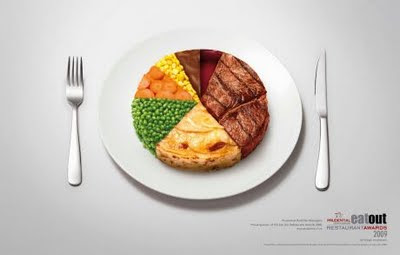
From Slides that Stick comes this image where a pie chart has the data represented with images instead of colors. This is an eye-catching and thought-provoking way to represent the data.Microsoft's loyal customers are finally getting the operating system they deserve with Windows 7, and it was well worth the wait.
First, to provide full disclosure (as critics have requested in our previous Windows 7 write-ups) yes, I am indeed a Mac user. But until heading to college, I grew up on a steady diet of Windows. (I made the switch after a system crash that resulted in the loss of an enormous school project.) With that said, Windows 7 thoroughly wowed me, dissolving the grudge I've held against Microsoft for many years.
The latest OS from Microsoft delivers a truly next-generation interface that will transform the way we use our computers, while addressing a number of nagging issues that have turned off Windows users in the past. The Windows team deserves a round of applause.
"Notice me"
If the new web has a mantra, that's it.
So much time and effort is now put into finding followers, accumulating comments and generating controversy... all so that people will notice you. People say and do things that don't benefit them, just because they're hooked on attention.
Attention is fine, as long as you have a goal that is reached in exchange for all this effort.
Far better than being noticed:
* Trusted
* Engaged with
* Purchased from
* Discussed
* Echoed
* Teaching us
* Leading
In a study of 23 non-football athletes who each kicked 10 field goals, researchers found that players’ performance directly affected their perception of the size of the goal: After a series of missed kicks, athletes perceived the post to be taller and more narrow than before, while successful kicks made the post appear larger-than-life.
Interestingly, the change in players’ perception didn’t just depend on how many goals they missed — it also mattered how they missed their goals. Folks who failed because they didn’t kick high enough perceived the crossbar to be taller, while those who kicked to the side viewed it as more narrow.
I've never minded addressing matters about which Scripture is clear, such as dishonesty, greed, sexuality, etc., but I've never felt I had a vantage point from which to comprehensively stand in judgment on all of culture. Quite often, I've known intelligent, sincere Christians who have stood on either side of some issues. If we are going to be divisive, it has to be about matters of good versus evil, which simply cannot be glossed over and replaced with Republican versus Democrat, or vice versa.The conversation turned to how Jesus addressed culture in his teaching and preaching. I think that Jesus was bold in addressing the cultural issues of his day, but he never aligned himself with any political or religious party. Jesus spoke in parables that would sneak behind peoples' prejudices and open their eyes to a different kind of culture. I think it was Michelangelo who said the best critique is to create something beautiful. Jesus critiqued culture by creating a better, beautiful culture.
What to you is the Gospel and where in scripture does this come from?
How much of the Gospel do you hear each week?
Does your minister/radio host/preacher always come back to Jesus even if he is preaching from Song of Solomon or Numbers?
Do you agree that each message should point back to Jesus every week?
I was really excited the way Ike Graul preached the Gospel this past Sunday as our youth group visited PUMP church of Christ. He pointed back to the sacrifice of Jesus and tied it to the Lord's supper. It was a very good way to wrap the entirety of our service to the Gospel of Jesus.
Cable news thinking has nothing to do with fires or with politics. Instead, it amplifies the worst elements of emotional reaction:
1. Focus on the urgent instead of the important.
2. Vivid emotions and the visuals that go with them as a selector for what's important.
3. Emphasis on noise over thoughtful analysis.
4. Unwillingness to reverse course and change one's mind.
5. Xenophobic and jingoistic reactions (fear of outsiders).
6. Defense of the status quo encouraged by an audience self-selected to be uniform.
7. Things become important merely because others have decided they are important.
8. Top down messaging encourages an echo chamber (agree with this edict or change the channel).
9. Ill-informed about history and this particular issue.
10. Confusing opinion with the truth.
11. Revising facts to fit a point of view.
12. Unwillingness to review past mistakes in light of history and use those to do better next time.
If I wanted to hobble an organization or even a country, I'd wish these twelve traits on them. I wonder if this sounds like the last board meeting you went to...
When you hear a piece of media described as “Christian,” what’s the first thing that comes to your mind? For me, if I’m honest, it’s that it is probably a piece of crap. It’s watered down music that is a poor imitation of pop culture, with different lyrics. It’s a poorly written novel that’s “more acceptable” to read because it’s been sanitized of harsh language/circumstances and deals exclusively with faith. It’s a straight-to-video movie with a cheesy plot and even worse acting. Most of all, I think it couldn’t be further from what God expects us to do with all of our creativity.
Jan Schultink over at Slides that Stick highlights how to stretch an image to fill a slide. There is nothing worse than have your image skewed or having awkward spaces around the sides. Here is how to do it:
1. Right-click the image, select format picture and click "reset picture" to restore the original aspect ratio (between height and width)
2. Re-size by dragging a corner until both the height or the width are at least equal to the full screen
3. Reposition the image and crop the bits of the image that are sticking outside the canvas
4. Select the image, press format and compress pictures to reduce the file size of your presentation
About AMI
The American Mustache Institute, the bravest organization in the history of mankind behind only the U.S. Military and the post-Jim Henson Muppets, is the world’s only facial hair advocacy and research organization, with more than 700 global chapters. AMI battles negative stereotypes and discrimination against Mustached Americans. Based in St. Louis due to the presence of the world’s largest mustache – the Gateway Arch – the organization is committed to recapturing the mustache’s glory years of the 1970s, when there existed a climate of acceptance, understanding, and flavor saving for people of Mustached American descent.