Find us on Google+
Showing posts with label speaking visually. Show all posts

Wednesday, February 15, 2012

What to Do When Words Don't Work

Recently Nancy Duarte featured Dan Roam on her blog and had him speak about his new book Blah Blah Blah: What To Do When Words Don't Work. In it, he discusses the two different minds that we have - the verbal mind and the visual mind. The verbal mind is all about words and grammar and it does really well in school. Schools are built for the verbal mind to excel, but they are difficult for the visual mind to navigate. What Dan does is to build a bridge between the two minds.

The problem has been that the Verbals have been in charge, only allowing the Visuals to work in a small sector. Verbals are CEOs and they allow Visuals to be in marketing or advertising, but it's always on the Verbal's terms. Visuals are expected to either get in line or get out of the way.

Dan shows, in the video below, how grammar is both a visual and a verbal construct. It's not just about one or the other, but ways in which both types of people can communicate together to make something more meaningful.

Are you a Verbal or a Visual?


Dan Roam - Vivid Grammar from Duarte Design on Vimeo.

Note: the book link earns me a small commission on any purchases made. I haven't read the book yet, so I make no endorsement.


Tuesday, April 19, 2011

Even Microsoft Gets It

Over at Microsoft's very own PowerPoint blog they point out that wrapping words around an image is just a bad idea. Avoid it, they say. Use a document creator tool, they say. Keep PowerPoint simple, they say.

That's what everyone else has been saying all along. Get rid of the bullet points and the text and focus on communicating visually through the powerful medium that PowerPoint provides. An image with just a few words is all it takes to convey a powerful message.

I know that PowerPoint automatically generates bullet points when you start typing text into the pre-selected text field. I'm sorry. Don't use it. Don't give in. Each slide should, as a general rule, be one, large picture with no more than six words.

The example here is from a recent presentation that I completed. Notice that it says a lot with very few words. I let the image do most of the communication and the words just give a framework for the image to put it into some sort of context.

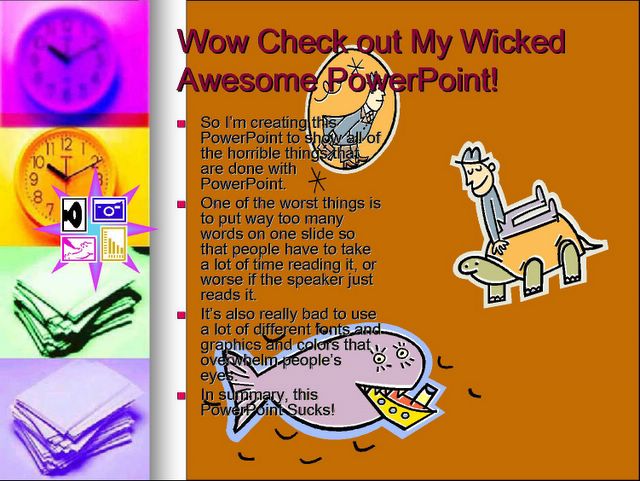
Even Microsoft understands that PowerPoint should be used more like this and less like this:

Monday, April 18, 2011

Charts and Graphs are Necessary

Where would we be without the wisdom of Stephen Colbert? He helps us understand why charts and graphs are essential to every good speech.


The power of Dr. Martin Luther King Jr.'s speech wouldn't have been as great without his Venn diagram.


Franklin Roosevelt inspired a nation by showing, in bar graph form, the challenges facing the nation.


Thank you Stephen, for setting us straight.

Friday, April 15, 2011

Visualize Doubt

© sframe - Fotolia.com
Doubts aren't the exception for life, they're the rule. If I'm honest with myself I doubt things all the time. I doubt whether my car will start in the morning. I doubt whether I will have enough money to pay my bills. I doubt the Theory of Relativity. I have moments when I doubt the existence of God. In truth I doubt pretty much everything that I don't both fully understand and fully control. The irony is that I'm sure that things that I understand and can control will happen the way I expect and they never do. Even what I'm sure about is open to doubt.

Stan Granberg had a great blog post on the Kairos Church Planting site entitled Preaching in Unbelief.

I propose the best way is to preach the gospel in the context of unbelief. Find your point of unbelief in the text. Hone it to a state of mental "scary sharp," then let God take you to his point of resolution from the text. There it is, the core of your sermon. Now wrap that core with a layer of street made reality and you have a sermon that will grip anybody. Probably even yourself.

It's precisely the point where we stop understanding where we can begin to grow. If we persist in speaking from a position of power, where we have everything figured out and tightly controlled, then we leave no space. Not understanding is frightening. Doubt is exhausting. The typical human response is to avoid, ignore and numb. God calls the leaders in his church to be the first into the breach. We lead the terrifying charge into the face of unbelief so that others can journey with us.

Let your doubt show through as you preach and you'll connect in a much deeper way.

Wednesday, April 13, 2011

Get Lost

© The Blowfish Inc - Fotolia.com
Imagination is a powerful tool. You can get lost in your own imagination. Daydreaming, doodling and pondering; we all have moments where our imagination runs away with us. When you're speaking to people though, you need to find those places where imagination and message coincide.

Instead of describing every detail of a scene for your audience, give them license to imagine the setting. Paint a picture with broad strokes then invite them to step inside with you.

"Paul and Silas were sitting in chains. The prison's bars kept them in but did little to shield them from the elements. The weather beat against them all day and into the night."

So were they hot or cold? Dry or wet? What does your imagination tell you? This is just a simple example of allowing space for imagination. But if we invite people to get lost with us then their minds will connect even more with what we're saying.

When using images, start a story. Don't finish everything, but show the beginning of action or movement. Let people imagine what happens next. If the photo is closely connected to your topic then the imagination will reinforce. But if the image is too tangential then it will distract.

What do you imagine from the picture with this blog? How have you engaged people's imaginations?

Tuesday, April 12, 2011

Fail Well

Failing might be a meme on the internet, but it's also important to being a success in life. Seth Godin points out that failure avoidance is actually working against yourself. If you plan to not fail you are planning to not succeed. For without failure and the subsequent lessons learned, we can't achieve any measure of success.

How can you plan to fail well in your public speaking? First, start by doing risky things. Speak a form that you aren't used to. Practice story telling or joke telling. Speak from a script if you typically use an outline. Use an outline or even no notes. Act out a dramatic scene or talk to the kids (they will let you know if you failed).

Try other things that are outside of your comfort zone. If you're a preacher then join a public speaking club like Toastmasters where you can't talk for half-an-hour about the bible. If you're like me it will challenge you and cause you to fail. Take up a hobby where you learn a new skill then perform that skill in public where there's the high risk of failure.

Learning to fail publicly gives us the confidence to keep trying new things. Experimentation is the only proven road to success, but it's filled with potholes. If you experiment, you will fail. But you stand the chance to learn valuable lessons about yourself and your craft through the process.

How have you failed well? What important lessons have you learned?

Friday, April 08, 2011

Make things Tangible

The United States Government is shutting down because congress can't agree on a budget for the remainder of 2011. The government shutdown will affect hundreds of thousands of people employed by the Federal institutions.

They are arguing over $37 billion. That sounds like a lot of money. To you and me that's a huge amount of money. But the argument that has shut down the wheels of governing is over less than one percent of the annual budget of $3,818.8 billion.

Less than one percent isn't that much at all. The average salary for an American worker is $42,000, so it would be the equivalent of asking you to lose $400 from your annual spending. That would be $33 a month out of your pocket. You could sponsor a child for less than that.

But the issue is bigger than that. See, the big problem with the budget isn't that we're spending our money in the wrong ways, it's that we're spending money we don't have. Our annual Federal deficit is 43%. That means that our government is spending way more money than it brings in.

So if this were you or me, we would be making $42,000 a year, but spending $74,000 - racking up credit card debt of $31,000 a year. So our friends and family have an intervention to help us get our wildly out of control spending in check. They sit us down and tell us that we can't leave until we write a budget that we can stick to. So we write up our budget for the next month (a month with $2,600 in debt-spending) and we trim $60. Then our friends and family tell us that it has to come from a different place. We can't spend money on popcorn at the movies anymore because that's not healthy. We refuse to budge on the popcorn issue. So none of us go to work the next week. That makes good sense and it's best for everyone involved. Right?

How can you use tangible details to communicate your message.

Thursday, April 07, 2011

Use Details to Connect

I don't connect well with generalities. Neither do you. When President Obama speaks, he doesn't share sweeping statistics as much as he singles out one person in a specific situation to make his point. Remember Joe the Plumber? He became a sensation during the 2008 election because he was "everyman" embodied.

If you want to speak with power and connect with people, then using specific details is important. This is another point that I gleaned from reading Made to Stick: Why Some Ideas Survive and Others Die. It's the details that make the story stick with people. There's a difference between statistics and details, however. I could tell you about the 300 million people in the US, and give you percentages that believe a certain way or act a certain way. But what will make the idea connect with you is if I tell you about my uncle or friend who had a real experience. Cancer is a vague problem until I know someone in chemotherapy who's tired and bald. 


Put a face on your ideas to let your audience visualize what you have to say. 


(Note: I earn a small commission from any books purchased through the link.)

Wednesday, April 06, 2011

Use Emotions to Connect

You might remember the website Save Toby from a few years back where the author posted several pictures of a cute bunny and said that he was broke and out of money. As a result he would have to eat his beloved rabbit if he didn't raise enough money to pay his bills. The donations started pouring in (along with the controversy à la organizations like PETA). The thing about the Save Toby campaign is that no matter how you viewed the website, it was engaging on an emotional level. I saw it as a great joke (humor), some people saw it as a tragedy and gave money (sympathy, pity), others saw it as a travesty and fought to shut down the site (anger).

One of the ways that ideas are sticky, according to  Made to Stick: Why Some Ideas Survive and Others Die, is that they provide an emotional connection. In one sense it doesn't matter much what emotion you use. They all connect people with an idea and get them moving toward action. But emotions will only carry an idea so far. After that something else needs to kick in and get people moving (joy, community, reward, purpose, etc.).

I don't know if you had a similar experience in youth group, but when I was going through there was a strong emphasis on emotional connection. We would spend time thinking about how our sins made Jesus suffer on the cross and even go so far as to nail a piece of paper with our sin written on it to a cross. There were a lot of emotions involved, but the change wasn't lasting because the emotions were mostly negative (guilt, fear, shame) and didn't connect to any positive way to change.

This isn't too far off of the hell-fire and brimstone sermons of a past age. The thought is that if you scare people or make them feel guilty, then they'll do what's right. That might be true, for the short term, but in the long run it won't be a lasting change.

A good presenter uses emotions to connect with people, but uses them wisely.

How do you provide an emotional connection when you speak?

(Note: the book link earns me a small commission on any sales.)

Tuesday, April 05, 2011

Made to Stick, How to Communicate Ideas

When you speak, most of your ideas will fall bounce off of people and disappear from them forever. A very few ideas have what it takes to stick with people. In the book Made to Stick: Why Some Ideas Survive and Others Die Authors and brothers Chip and Dan Heath explore the stickiness of some ideas over others. They start by looking at the incredibly sticky ideas that are urban legends. Urban legends connect on an emotional level with concrete details yet have a twist at the end that really draws us in. They obviously wrote an entire book about how to make ideas stick (and you should read it, it's good stuff), so I won't explain everything they've said so well.

I want to share one of the points that they make that relates to public speaking. Good communication is aware of schemata. A schema (the singular of schemata) is a psychology word used to describe a pattern of thoughts. One of the examples in the book is the schema of a chair. We hold in our thoughts the idea of what a chair ought to be and do, and that can encompass a huge variety from folding metal chairs to plush leather wing-back chairs. Connect your idea to a schema that people are already familiar with and you are letting them do most of your communication. So I can tell you about a rickety wooden chair and you have a fairly clear picture of what I'm talking about. I added two words to the chair-schema and that is sufficient to differentiate one chair from millions of others.

How can you use schemata to communicate more effectively?

(Note: The book link earns me a small commission on any sales)

Monday, April 04, 2011

April Theme - Speaking Visually

No matter how good your PowerPoint slides are, your presentation will only be as good as you are. Everything begins and ends with how you present. If you're a great public speaker, adding PowerPoint slides can connect more people with your message in more ways. But if you skimp on the speaking skills, the slides will do little to bolster a poor talk. So, for the month of April I want to focus on the theme of presentation skills.

Specifically, I want to look at speaking visually. It's important for us to create vivid images with our words so we can connect what we have to say with what's going on in the brains of our audience. Our brains function as primarily visual/spatial processors which means that if you aren't giving people queues to help them visualize what you're saying, then they likely will miss much of what you're attempting to communicate. It's as if our brains are vast art galleries with paintings on the walls and blank canvases stacked up in the corners. You can access a painting that people already have up and link what you have to say to what they already know. You essentially give them a mental post-it note attached to that painting. So now they associate what you said with their previous mental image. If you want to talk about teamwork, you can point to their memory of little league or to a famous team incident so you tag on to what they've already visualized.

Or, you can lead them in painting on a fresh canvas, but we can talk about that more tomorrow.

How do you help people visualize what you say?