How is it possible to say anything new about the most familiar parable in the world? Yesterday I faced that question as I preached the parable of the Good Samaritan to the Oregon City Church of Christ. I was honored to fill in while the ministers were away and I continued their series on the parables of Jesus. I chose the Good Samaritan, in part, because I already have a familiarity with it, but that familiarity was the first hurdle I would face.
It's possible that the parable of the Prodigal Son is as well known as that of the Good Samaritan, but that's only to say that they are among the very few stories of Jesus that have infiltrated popular culture. It's common to hear a news story about a Good Samaritan who helps someone in need. There are hospitals all over the nation named after the compassionate deeds of a character in a story. We hear this message and have our immediate expectations about how it ought to be interpreted.
The Good Samaritan is obviously a story about why we should take care of people on the side of the road. We need to look after the weak and injured among us. Even a lowly Samaritan did the same and showed mercy on an injured, naked man. And we leave it at that point. Our familiarity prevents us from seeing any more than just the beginning of the point.
I believe that what we've turned into the main point of the parable is a secondary point and that Jesus was wanting to communicate something more by the telling of the story. But I'll dig into that a bit more tomorrow.
How do you deal with familiarity when you teach on common texts?
Showing posts with label bible. Show all posts
Monday, October 24, 2011
Wednesday, September 07, 2011
Messy Life
The beginning of Jesus story in Matthew is a genealogy. That seems a bit dry, boring even, for the start of such a story. But nevertheless, that's where it begins. It starts off well for the Jewish audience reading Matthew's words. They cheer on Abraham, Isaac and Jacob as the patriarchs of their people, but before long, the mess starts to creep in. The shameful story of Tamar and Judah is mentioned. The cheering becomes abashed mumbling, here in the lineage of patriarchs and kings is the story of a woman pretending to be a prostitute to seduce her father-in-law and get an heir.
Not much later is the story of Ruth and Boaz where Ruth makes it appear that Boaz has slept with her while he was drunk in order to back him into marriage. Then David, the man after God's own heart, is also the murdering adulterer.
By the time the genealogy gets to the kings of Judah the mess just keeps coming. There will be a few good kings, and then many bad kings. Finally the kingdom ends in exile for the people.
Jesus comes into this mess, not as a conquering king, but as a bastard child. Mess on top of mess. The story of Jesus is the story of us and our story is a mess. Jesus could have come and shown a parallel path, a different way that isn't filled with this mess. Instead, Jesus shows a way through. He looks to redeem the mess, not ignore it or replace it.
What do you do with the mess in your life? Do you seek to avoid it or to work through it?
Not much later is the story of Ruth and Boaz where Ruth makes it appear that Boaz has slept with her while he was drunk in order to back him into marriage. Then David, the man after God's own heart, is also the murdering adulterer.
By the time the genealogy gets to the kings of Judah the mess just keeps coming. There will be a few good kings, and then many bad kings. Finally the kingdom ends in exile for the people.
Jesus comes into this mess, not as a conquering king, but as a bastard child. Mess on top of mess. The story of Jesus is the story of us and our story is a mess. Jesus could have come and shown a parallel path, a different way that isn't filled with this mess. Instead, Jesus shows a way through. He looks to redeem the mess, not ignore it or replace it.
What do you do with the mess in your life? Do you seek to avoid it or to work through it?
Monday, March 14, 2011
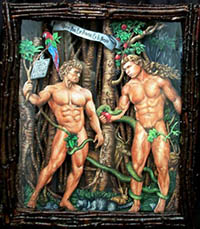
Homosexuality and the Bible
![]() |
| Adam and Steve in the Garden of Eden |
When reading the bible we all have our biases that affect how we read and interpret scripture. The bias of a patriarchal society allowed some people to read the bible as teaching the subjugation of women. The bias of being slave owners allowed some people to read the bible as being in favor of slavery. As our biases change, so too does our reading and understanding of what the bible says. First it's important to look honestly at our biases and see how they're affecting our reading of God's word.
The typical Christian bias is that homosexuality is a sin and that the bible teaches against homosexual relations in a strong manner (though we saw that there are only just a few passages on the topic). It's no wonder that when we come to the bible that we see a condemnation of homosexuality if that's exactly what we expect to find there before we open the book. If we aren't willing to move the conversation to the level of bias we won't be able to move forward. What if the standard Christian bias is wrong? That's exactly the question that we're asking homosexual Christians to consider.
In conversations that I've had with homosexual people and people who interpret the bible to say that homosexuality isn't a sin I think I've identified a couple biases that inform their interpretation of scripture. Please note, this is my opinion based on personal conversations, I welcome corrections and critique. The first bias has to do with happiness. The essential argument is that God must want us to be happy and that romantic relationships are key to happiness. The second bias is that homosexuality is an innate trait rather than a chosen behavior.
There is growing evidence that homosexuality is, at least partly, controlled by genes. Numerous people have gone through gay-cure programs such as Exodus International. And while there is a good deal of debate about the "success" of such program (Exodus won't even comment on the topic), there are many who come out feeling hurt by the process of rejecting who they have been their entire lives. I couldn't choose to be heterosexual, I just am. It follows that homosexuals can't make the choice either.
The first bias of homosexual theology essentially says that God wants us to be happy. Here's where I think the conversation needs to focus. Does God really want us to be happy? Is our happiness inextricably tied to our ability to love whomever we want?
I'll keep discussing this point tomorrow. What do you think?
Labels:
bible,
church,
exodus international,
homosexuality,
jesus,
mark adams
Friday, March 11, 2011
Homosexuality and the Church
Continuing the conversation from yesterday about Jesus and the homosexual community, I want to think a bit today about what the church needs to do. If we're going to have this conversation, it needs to be based in what the bible says. A conversation can't happen when we're shouting at each other. I learned this from Carroll Osburn in his book: Women in the Church: Reclaiming the Ideal
, which looks at the different sides of the issue of women in the church in a fair and reasonable manner. Essentially the conversation can't happen between the extremists. People holding signs saying that God hates homosexual people are not likely to do anything but shout, and the radical, vociferous minority of the homosexual community won't listen or respond coherently either.
We need to have an honest, theological and scriptural discussion not an argument. Stanley Grenz has a highly recommended book that presents different biblical interpretations and lands on the idea that the church ought to be: Welcoming but Not Affirming
. In it he lays out both sides of the issue and looks at the scriptural underpinnings of the debate.
The reality is that there is a dearth of scriptural teaching on this point. We have all of four passages in the bible that mention it at all: Leviticus 18:22 and 20:13, 1 Corinthians 6:9-10 and Romans 1:26-27. Some would also cite the destruction of Sodom and Gomorrah as a condemnation of homosexuality since the men of the city wanted to have sex with the angels visiting Lot. However Genesis 19 isn't clear about the reason for the destruction of the city.
Leviticus is the most clear about what the actual act being prohibited. It only covers male homosexual acts, however and doesn't condemn all homosexuality. Some would argue that this is due to the patriarchal society which sees women as unnecessary of mention. There is thought that the homosexual practice being prohibited is not a loving, consentual relationship, but rather cultic practices that relate to the worship of the Canaanite gods. Similar to tattoos and beard trimming that were both outlawed in Leviticus for what appears to be the purpose of keeping the Israelites from idol worship. Christians have dismissed the teaching about beard trimming, by and large, and many Christians don't see a problem with tattoos. The same reasoning could be used to dismiss the commands about homosexuality in Leviticus.
In 1 Corinthians we see a list of things that will exclude people from the kingdom of heaven, one of which is being a "homosexual offender." This could be taken to mean anyone who has homosexual relations, but within gay theology they argue that this is actually in reference to homosexual pedophilia which was common in Roman and Greek culture where an older man would take a young boy as a lover. Their argument is that Paul is outlawing, not the relationship between two adults, but the dominant relationship of a man over a boy as sinful.
Romans gives us the only teaching about female homosexuality in the bible. To me, this is the most difficult one to dismiss, as it is fairly clearly talking about both men and women and apparently adult relationships. It takes more exegetical gymnastics to get around this passage. You could say that Paul is discussing temple prostitutes again. Or it could be a discussion of the ways in which sex and rape were used to exert dominance over weaker people and to fill them with shame, pointing out that everyone is shamed by such acts.
I think that's the basis for a biblical discussion. I believe that the bible teaches that homosexuality is a sin, but it is in no way a greater sin than others. Paul lumps it in with being drunk, greedy or a slanderer. Truth be told, Christians slander homosexuals regularly. It's time to stop slandering and start conversing so that we can understand each other.
What do you think?
(Note: book links earn me a small commission on any purchases).
We need to have an honest, theological and scriptural discussion not an argument. Stanley Grenz has a highly recommended book that presents different biblical interpretations and lands on the idea that the church ought to be: Welcoming but Not Affirming
The reality is that there is a dearth of scriptural teaching on this point. We have all of four passages in the bible that mention it at all: Leviticus 18:22 and 20:13, 1 Corinthians 6:9-10 and Romans 1:26-27. Some would also cite the destruction of Sodom and Gomorrah as a condemnation of homosexuality since the men of the city wanted to have sex with the angels visiting Lot. However Genesis 19 isn't clear about the reason for the destruction of the city.
Leviticus is the most clear about what the actual act being prohibited. It only covers male homosexual acts, however and doesn't condemn all homosexuality. Some would argue that this is due to the patriarchal society which sees women as unnecessary of mention. There is thought that the homosexual practice being prohibited is not a loving, consentual relationship, but rather cultic practices that relate to the worship of the Canaanite gods. Similar to tattoos and beard trimming that were both outlawed in Leviticus for what appears to be the purpose of keeping the Israelites from idol worship. Christians have dismissed the teaching about beard trimming, by and large, and many Christians don't see a problem with tattoos. The same reasoning could be used to dismiss the commands about homosexuality in Leviticus.
In 1 Corinthians we see a list of things that will exclude people from the kingdom of heaven, one of which is being a "homosexual offender." This could be taken to mean anyone who has homosexual relations, but within gay theology they argue that this is actually in reference to homosexual pedophilia which was common in Roman and Greek culture where an older man would take a young boy as a lover. Their argument is that Paul is outlawing, not the relationship between two adults, but the dominant relationship of a man over a boy as sinful.
Romans gives us the only teaching about female homosexuality in the bible. To me, this is the most difficult one to dismiss, as it is fairly clearly talking about both men and women and apparently adult relationships. It takes more exegetical gymnastics to get around this passage. You could say that Paul is discussing temple prostitutes again. Or it could be a discussion of the ways in which sex and rape were used to exert dominance over weaker people and to fill them with shame, pointing out that everyone is shamed by such acts.
I think that's the basis for a biblical discussion. I believe that the bible teaches that homosexuality is a sin, but it is in no way a greater sin than others. Paul lumps it in with being drunk, greedy or a slanderer. Truth be told, Christians slander homosexuals regularly. It's time to stop slandering and start conversing so that we can understand each other.
What do you think?
(Note: book links earn me a small commission on any purchases).
Thursday, March 03, 2011
I Might be Wrong
After years of careful study and reflection, I finally admitted that I was wrong. It was tough, but eventually I became convinced that it was best to just change rather than continue to fight against what I know to be incorrect.
My process involved a thorough study of the bible and biblical interpretation including the traditional interpretations alongside the original language and historical setting. I talked with lots of people and reflected throughout the process. I prayed for wisdom and kept reading the bible to look for what God is trying to say through scripture. In the end I became convinced that what I had always thought was actually wrong and that the bible was teaching something different.
I'm avoiding the specific topic (partly because this has happened several times on different issues), because I don't want to derail the conversation by getting into the details of a certain doctrine. What's more important, I think, is to have an attitude of submission to scripture where we recognize that what God teaches through the bible is greater than our opinions or traditions, and if God is teaching something through scripture that contradicts what I've always believed, then my beliefs need to change. It's painful. I don't like it. But in the end it's better for me and it's better for the people of God to actually let the word of God be our authority.
When have you admitted to being wrong? How did you go through the process?
My process involved a thorough study of the bible and biblical interpretation including the traditional interpretations alongside the original language and historical setting. I talked with lots of people and reflected throughout the process. I prayed for wisdom and kept reading the bible to look for what God is trying to say through scripture. In the end I became convinced that what I had always thought was actually wrong and that the bible was teaching something different.
I'm avoiding the specific topic (partly because this has happened several times on different issues), because I don't want to derail the conversation by getting into the details of a certain doctrine. What's more important, I think, is to have an attitude of submission to scripture where we recognize that what God teaches through the bible is greater than our opinions or traditions, and if God is teaching something through scripture that contradicts what I've always believed, then my beliefs need to change. It's painful. I don't like it. But in the end it's better for me and it's better for the people of God to actually let the word of God be our authority.
When have you admitted to being wrong? How did you go through the process?
Labels:
bible,
interpretation,
scripture,
study,
word of God,
wrong
Subscribe to:
Posts (Atom)