Find us on Google+

Thursday, May 19, 2011

Facebook Lists

One of the features of Facebook that can help with targeted communication is the use of lists. A Facebook list is just a sub-group of your friends online, but you can use that grouping to target your status update or see only the statuses of people in a certain community.

Create a list by clicking on the "Friends" link under your picture on the left side of the Facebook screen. Then click the "Edit Friends" button at the top of the screen and then click the "Create a List" button. Give the list a name in the top box, then add people to the list. You can search by name, or scroll through all your friends. Once the list is created you can add people easily through a recommendation system and when you add new friends you can assign them to a list.

Now that the list is created, you can put it into practice by clicking back to the feed page. Click the "Facebook" logo in the upper left corner. Now you can click the arrow next to "Most Recent" (click "Most Recent" if you don't see the arrow at first). Choose the title of your new list from the menu that drops down. Now your news feed is only showing the people from the list you just created.

Click in the status update box then click on the padlock icon next to the "Share" button. Select "Customize" then choose "Specify People" from the drop-down menu. Type the name of your list into the box and it will appear like a person in your friend list. Click "Save Settings" and that status update will only go out to the people on your list.

How can you use lists to better communicate online? Do you use this feature?

Wednesday, May 18, 2011

Good News

Talking about spreading the gospel through the use of technology is really a conversation about speaking good news to people. People want to hear good news. It's instinctive for us to listen to good news and then want to share it. This can make sharing good news online even more difficult.

It might sound counter-intuitive to say that human beings love to share and hear good news so sharing good news will be tough, but it's the medium that affects the message here. Everyone is free to post whatever they want on Facebook or Twitter or Blogs. Because of that there's no shortage of news coming in. A lot of the news will be good. So the amount of noise that can drown out your message is huge. You might have the best news in the world, but it gets lost in the din.

One strategy that people will use online is to post more often. That can work, sometimes and in short spurts, but if you keep doing it people will tune you out, un-follow or de-friend you. Another way that people try to share good news online is through linking and quoting. Posting links to news stories or inspirational quotes from famous people or the bible is thought to lend authority to the claims of good news. The trouble is that most of the time it does the opposite and allows people to doubt the source.

Good news isn't best shared through blasts of information or through quotes and links online. Those tools are more likely to cause people to be numb to your voice on the internet rather than to hear what you have to say.

So, how do you think people can best share good news online?

P.S. I'll talk about this more tomorrow, but I wanted to hear your thoughts first.

Tuesday, May 17, 2011

Google Images

Over at Google they've made some changes to the way that Google Images handles requests. You can still enter a search request and get the most relevant images returned to you. But now they've added a new way to sort the results you get. Instead of sorting by relevance, you can sort by subject.

Click on the "Sort by Subject" link to the left of the images after you start a search and you will see the different subject for that search. For example, if you search for "Church" you'll get a categories for "Catholic Church" "Baptist Church" and "Inside Church" among others. Then you can click on the subject title to see all the images from that subject. On many of the image searches you can keep following the subject trail down to continue refining your search. If you chose the "Inside Church" subject you could get more subjects underneath that, like "People Inside Church" and "Inside Old Church."

Check out the video below to see more about the new searching features.

Monday, May 16, 2011

Selling Jesus

Seth Godin shares about the difference between selling and inviting people. When you're selling, it's time to convince, cajole and persuade people to think differently. When you're inviting, the convincing has already been done and you're just helping people through the steps of a decision that's already been made.

As I was growing up I learned evangelism through the lens of sales. We should use apologetics to convince people of the truth of Jesus. For every objection that people could bring, we needed to be able to bring a response. Books like A Case for Faith were incredibly popular since they answered all the hairy questions about faith.

But somewhere along the way that process stopped working. Maybe it never worked, I don't know. All I know is that now, if I try to sell someone on Jesus, I'm going to be worse off than I was when I started. They won't be convinced and we won't be friends anymore.

The other option is inviting people. But you can't just invite people to something they don't want to do. So we need to live inviting lives. We need to be the types of people that our friends want to be around and to learn more about. We need to live lives that beg the question: "Where does your hope come from?" (1.Peter 3.15) And then once people are already sold on Jesus by seeing his impact on our lives, we invite them to Jesus. We walk with them through the steps of making a faith decision.

Does selling people on Jesus still work? Did it ever work? What works in your context?

Friday, May 13, 2011

Authenticity Online

Some people think that Facebook is killing authenticity online. Blogger Steve Cheney says:

The problem with tying internet-wide identity to a broadcast network like Facebook is that people don’t want one normalized identity, either in real life, or virtually.

People yearn to be individuals. They want to be authentic. They have numerous different groups of real-life friends. They stylize conversations. They are emotional and have an innate need to connect on different levels with different people. This is because humans are born with an instinctual desire to understand the broader context of their surroundings and build rapport, a social awareness often called emotional intelligence.

To an extent I agree. We don't tend to want the same identity from one social sphere to the next. We'll be one person at work, another at home and still another with our friends. Going online allows us to be whomever we want. We can invent a persona that plays World of Warcraft and is a foul-mouthed tough, online. But then we go to our day-job as a preacher with lots of piety.

Cheney thinks that keeping the boundaries between social spheres allows us to be more authentic. It allows us to share what we really think online when we know that our spheres aren't co-mingling. Here's where I start to disagree. The co-mingling of all our social interactions is actually forcing us to be more authentic. We need to be the same person at work, home, school, church or playing video-games online. Instead of being trapped in shallow identities that define us in one sphere, but don't really have anything to do with the rest of our lives, we can be whole people.

Maybe I can't unleash my snarky comments on a tech website or a string of expletives while gaming, if all of that is connected to social media. What if knowing that my mom is watching me online is actually helping me to be a better person, more authentic and whole? I know that I say things that are offensive or difficult for some people, but I don't say them to be offensive, I say them because they come from me. That's more authentic than a dozen separate profiles and as many separate identities that I have to keep up with. I just get to be a whole person, authentically me.

How do you think Facebook helps or hinders authenticity?

Thursday, May 12, 2011

Types of Facebook Users

Stereotypes can be fun sometimes. But only when they aren't intended to offend anyone. I'm not wanting to give offense, just look at some of the ways that people can be stereotyped on Facebook. Just so you know, several of these apply to me, so I'm not trying to be unfair or mean, just observant.

Game-Booker - She only posts about her current needs in FarmCityMafiaVille. Your correspondence is comprised of requests to play the game with her.

Omni-Booker - He tells you everything that he's doing from morning to night. "I woke up with lines on my face." "We were out of cereal for breakfast." "There's bad traffic on the 5 today."

TMI-Booker - She shares way too much information online in public: "I had some runny poo today, I wonder if it's because of all the bran muffins."

LOL-Booker - He thinks that the abbreviation for Laugh Out Loud is a punctuation mark. "The dog is wet and smells LOL" "My hamster just died LOL"

Cause-Booker - She believe strongly in a lot of different causes - and every one of them shows up in the status updates. You don't know where she lives, but you know her top 22 charities.

Spouse-Booker - His updates all center around how much he loves his spouse. They have the added benefit of being an emetic.

Link-Booker - She shares links with you. Every link. All the time. Instead of status updates you get links to videos, websites and Groupons.

Statistical Guilt-Booker - He reposts the status about people who have cancer, diabetes, ugly kittens or excess phlegm then adds the barb that if you don't repost it as your status you're one of the 97% who don't care enough.

Photo-Booker - Rather than status updates, she takes pictures of everything she does and posts them on Facebook. Often she's using her mobile phone so the pictures are coming in as the action is happening.

Food-Booker - Every post he makes is somehow related to food. Food he just ate, food he's about to eat or food he just bought. Extra bonus if this is also the TMI-Booker and you get to hear the final fate of the food.

Quote-Booker - She shares quotes that inspire her. But none of her own words. Or she might share her favorite quotes from TV shows (without regard to the fact that she's watching the show live and ruining it for people with DVR or Hulu).

Baby-Booker - Every status update consists of minute detail about the progress of a baby. "Horatio just had his first poo." "Cyrano is sleeping for 3.783 hours at a stretch now."

Blog-Booker - She only posts statuses that are also links to her blog posts. Who would do such a thing?

Ego-Booker - His posts are all about self-promotion. His new project. His new website. His new album. His new article. It's all about him.

Vague-Booker - Her posts are never quite clear what they mean and usually prompt at least one comment asking what's going on. Vague-Bookers can also be Passive-Aggressive-Bookers.

Twitter-Booker - He posts to Facebook through Twitter so all the status updates are littered with Twitter-bit like hash-tags and at-replies. "Totally just saw @jtw78 at #pbl11 #sweet"

What other stereotypes have you come across?

Special thanks to my friends for helping me to come up with this list (via a status update on Facebook no less): Arwen, Spencer, Rebecca Marie, Morgan, Rich, Ryan, Ben. You guys rock.

Wednesday, May 11, 2011

Dealing with Trolls

If you aren't familiar with the term, 'troll' when it comes to the internet, allow me to enlighten you. A troll is someone who posts annoying, frustrating, abusive or inflammatory comments online. If you've spent any time commenting on any website you've probably come across a troll. They might be the person who argues with every point you make or just says things that are infuriating to you.

Trolls are a symptom of the internet. People can think they're anonymous online and so some of their social inhibitions will drop and they might say things that are offensive. In real life they might never be so abrasive, but being online behind a keyboard allows them the freedom to say more than they otherwise would.

Trolls are not necessarily bad people, but they can certainly elicit some bad response. I know that I've gotten pretty mad at some comments made online and put my foot in my mouth more than once. It's my responsibility to deal with my emotional reactions, not to censure the comments of other people that might offend me. The lack of any body language or tonal queues online makes it very easy to interpret comments in the least positive way possible.

Troll Handling Tips:

  • Don't feed the trolls
    If you find yourself getting angry at what someone says online. Stop. Wait. Don't respond right away. Take time to cool off. Ask yourself if this conversation will help anyone. If the answer is: No. Then stop. Ignoring a troll is the best way to get them to go away. 
  • Don't bait the trolls
    Certain types of status updates and blog posts are perfect troll-bait. If you post something about politics, money or religion be sure you know what you're saying and what you're getting yourself into. Those flavors are especially tempting to trolls. Read your content before posting and look for ways that it might be divisive or offer a platform for offensive comments.
  • Love the trolls
    They might be saying some frustrating things on your Facebook page or blog posts, but trolls are people too. They have reasons for what they say. Take the time to understand them. Put yourself in their shoes for a moment. If you read your comment out loud in the most sarcastic tone of voice you can muster, how does it come across. Maybe you started it. Now read their comment in a sweet, nice tone. Changing the tone can make a huge difference. Don't assume that everyone is out to troll you. 
  • Fight the trolls
    As a last resort, you might need to stick your nose out. Don't fight trolls on your behalf. Take any abuse they heap on you. Don't delete them as friends. Don't delete their comments. Those actions would constitute troll baiting. Don't, however, allow trolls to abuse other people. You won't be able to foster good conversations online if people are constantly afraid of being trolled on your site or page. Your weapons are simply these: block, delete and ignore. Don't point out why they're wrong, or try to defend your actions in any way (more troll-bait), just don't allow trolls to abuse other people on sites that you control. 
What tips do you have for dealing with trolls online? 

Tuesday, May 10, 2011

Google Searches Visualized

I'm always on the lookout for cool ways to show information. What we see is often more important than what we know. Since vision is our primary sense and we filter all the rest of our input through vision, it's important to make things like data visually engaging and appealing.

Google took and showed the volume of searches by language and region on a globe. You can spin it with your mouse and zoom in our out with your scroll wheel. It's captivating and fascinating where a spreadsheet with numbers or even a standard bar graph would be boring.

How can you make the information you share more visually engaging?

Monday, May 09, 2011

SlideFest: Microsoft's Presentation Competition

I submitted a few entries into Microsoft's first annual SlideFest PowerPoint competition. If you like any of these that I've done you can vote for them from May 9th through the 23rd. If I get the most votes then I win an Xbox 360 and a copy of Office 2010.

Mostly I'm excited to share some of my hard work and what I've been learning about presentation design. Putting these together stretched me and helped me to learn some new skills. I'd be pleased to know what you think, and get your votes.

Click on one of the thumbnails to the right (or the links below) to see the slideshows I put together.

Neural Pathways

Stage Fright

Friday, May 06, 2011

Crowd Power

© Dmitry Nikolaev - Fotolia.com
For all of the ways that interaction online doesn't quite match up to connecting in real life. There are ways that the internet far outstrips flesh and blood connections. One example is the group coupon sites like Groupon and Living Social. Recently Wired wrote about the phenomenon.

In real life you can't easily organize hundreds of your friends to all purchase the same deal on the same day so that you all get a better price from the vendor. Sure you could work with a few of your friends to get a deal at your local hangout, but you would never have the ability to get so many deals or such good deals.

The magic behind things like Groupon is that they are local enough to target a specific business, but distributed enough to get lots of people involved. The businesses get half of the money Groupon collects up front, so instead of paying for advertising, they're being paid for it. Then they're guaranteed that the people who have the coupon will want to come into their store since they've already paid money for the opportunity. Consumers are thrilled to get prices in the range of 50% (or more) off and to be discovering new, local places.

This one is going to take a little bit more work to apply to what's going on in your church than we've done previously. Developing relationships is the same for you as it is for other people. But you can't start offering Groupons to your church bookstore. That's not the way to apply this bit of learning.

Step back from the monetary side of things and notice that these are local, but distributed. Here's a thought, if you have a large church, and you were already planning on giving some money to a relief fund (like Japan, Haiti, etc.) see about offering a Groupon that will match donations and then throw a fund raising party. So people would buy a $15 voucher good for $30 in donations. If they bring that to the party they can get another $10 donated to the cause. Plus hang out with people who want to do good in the world. Better yet, make it local to your city - help to refurbish a derelict park or start a tool library.

How could you imagine using the power of crowds available online?

Thursday, May 05, 2011

Humor Online

Funny stuff is funny. Deep, I know. What we don't want to do is scour all humor from our world. Laughter is healthy and it connects people together. But humor can also be used to hurt people. Bullies use humor as a weapon to destroy.

Scientist, Peter McGraw, think's he's cracked the humor code.

Philosophers had pondered this sort of question for millennia, long before anyone thought to examine it in a lab. Plato, Aristotle, and Thomas Hobbes posited the superiority theory of humor, which states that we find the misfortune of others amusing. Sigmund Freud espoused the relief theory, which states that comedy is a way for people to release suppressed thoughts and emotions safely. Incongruity theory, associated with Immanuel Kant, suggests that jokes happen when people notice the disconnect between their expectations and the actual payoff.
But in the end, none of the theories alone could account for all the types of humor out there (especially Sarah Silverman). McGraw came up with the idea that humor is benign violation. He uses the example of tickling, if you tickle yourself you're not violating anything since you know it's coming. If a stranger in a trench-coat tickles you it's not benign, just creepy. But if your friend tickles you, it's both benign and a violation at the same time.

Making jokes about people have been off limits for most professional ministers. You can't make fun of people because someone might get offended. That's not a bad rule to follow in preaching and public speaking. But when it comes to developing relationship online, eschewing humor is (or would be for me) like cutting off your left arm and replacing it with a jellyfish. It's not helping anyone.

I think we're all pretty clear on the violation part of humor. We need to violate a social norm, an expectation or even the rules of grammar in some unexpected way. What we need to do is create more benign space for humor to happen. Jokes that are racist or sexist are only seen as funny when the teller feels safe and disconnected from the object of the joke. Being vulnerable with people keeps us from feeling safe telling offensive jokes, they stop being funny. But, then as the vulnerability increases and we learn to trust each other more, we can expand our humor palette.

When we've done the work to develop the relationship and the shared vulnerability, then we can really laugh with each other. We know that the jokes are benign rather than just being violations.

How do you create space for humor?

Wednesday, May 04, 2011

Facebook as a Relational Space

Most of us have a pretty good handle on how relationships work in real life. But the etiquette on Facebook is different. You need to be on Facebook, but you need to do it well.

You need to decide why you're on Facebook, or any social media site. Do you want to promote your project, play games or share what you had for dinner? The option is yours, but you have to know that some approaches are better than others when it comes to building relationships.

Think about how you build relationships in real life - Facebook and the rest of the internet aren't so different. It's a dance of vulnerability. Each person offers a bit of vulnerability and, if they receive kindness in return, then more vulnerability. If, however, the vulnerability meets with rejection, derision or apathy, the relationship will shut down.

If you are rejecting people, making fun of them, ignoring them or doing anything that would be rude in real life, that will destroy vulnerability and kill a relationship online. With tools like Facebook the problem is exacerbated since everyone can see your interactions, so if you make fun of someone for expressing their opinion on something, then everyone who sees that interaction will become slightly less vulnerable to you.

But wait! What about humor? Yes, humor has a place, and a formula. I'll pick up that thread tomorrow.

For now, how are you vulnerable online? How could you foster more vulnerability?

Tuesday, May 03, 2011

Relational Space Online

© lunamarina - Fotolia.com
There are four traditional spaces for relationship. Each space has its own rules that our culture applies to govern the relationships in that space.


  1. Public - Anonymous to surface-level relationships. Large personal bubble. Crowd sized group.
  2. Social - Surface-level to friendship relationships. Smaller personal bubble. Some sharing conversation. 15-50 group
  3. Personal - Friends to good-friends. Smallest personal bubble. Deep conversation. 3-12 group.
  4. Intimate - Closest friends and spouse. No personal bubble. Deep sharing. 1 or 2 people besides you in the group.
Those categories are useful for real life reaction. We know precisely when something is public or personal. For example, Sunday gatherings are usually public space, bible classes and potlucks are social space, small groups are personal space and intimate space is with your spouse or best friend. 

What about interaction online? Posting a status on Facebook can feel very personal since you are typically sitting by yourself at your computer when you type it in. But then every one of your friends gets to see it, and comment on it, not just the ones in your personal sphere, but your social and even public spheres. Conversations can get intimate online (which isn't a bad thing), but when that happens in a public space that can be damaging. 

Here's a bit of practical advice for relational space online. Only post things publicly that you would also announce at a friend's party. Use the groups functions on Facebook to post more personal stuff to just your friends. Have private conversations through the chat or personal message features, not in public on someone's wall. Think of the different areas on Facebook or other social websites as actual physical spaces. The Facebook wall is the outside of the house where everyone can see. What would you put up on the wall of your house? A friend's house? If you're going to have a personal or private conversation, you go inside. 

How do you think relational spaces work online? 

Monday, May 02, 2011

May - Spreading the Gospel with Technology

In August I've been asked to speak at the European Christian Workshop in England. My topic is how to share the gospel with technology. A lot of this blog centers around that topic, but for the month of May I'm going to focus on it. A little bit I'm using the blog as a way to also prepare for the conference, but I'm also wanting to leverage the thoughts of my readers in figuring out this important issue.

What ways do you use technology on a daily basis?

How is technology helpful in spreading the gospel?

How does technology make it more difficult to spread the gospel?

Thanks for your help.

Friday, April 29, 2011

Singing, Acting and Preaching

© U.P.images - Fotolia.com
In my life I've been a singer, an actor and a preacher. The three disciplines have a lot in common. Sure, you're up on the stage in front of people for all three, but beyond that, there's still more that's common between them.

Singing requires practice, focus, emotion and control. Unless you're one of the rare people who can pick up a new song and sing it immediately, you need to spend time practicing so that it will come out sounding right. You also need to focus. If you're singing with a group or with instruments you need to sound good with everyone else, not just on your own. You need to blend with the other sounds, tune to the other pitches and focus on how it all works together. Great singers make us believe what they're singing by showing emotion. They draw us into the song with the way they perform and evoke emotions in us. Finally, singing takes control. You need to be able to change the volume, pitch or intensity instantly. You can't just cut loose and belt it all out, you need to keep your voice tightly controlled when singing loudly or softly.

Acting takes many of the same skills and preparation, but one thing that I learned from acting is that you need to make everything you do bigger than life. The stage is small and far away from the audience. For them to see what you're feeling you need to make the expressions on your face big. Bigger than you would in a personal conversation. It's uncomfortable and weird to stretch your face so large in a smile or a frown, but it communicates to the back row. Also good actors have great diction. They enunciate clearly, but not so much that it's awkward. They don't leave off letters or sounds that the audience needs to hear to know what's going on. A good actor doesn't need a microphone to be heard, clearly. It's not just shouting, but speaking with force and precision.

So all of this has been mixed into my preaching style. I practice my sermon several times before I give it. I don't just sit and read through the sermon, I stand up in the auditorium and preach it to the empty room. I do this at least twice before every sermon. My preaching needs to blend with the rest of what's happening on Sunday. I can't overpower or contradict the singing, praying or audience. I need to show my emotions as I preach. I may be familiar with the subject matter, but the audience isn't I need to show on my face how I reacted the first time I heard the message I'm preaching.

What has helped you to be better at the art of preaching?

Thursday, April 28, 2011

The State of Presenting with Nancy Duarte

In this brief, compelling interview, Nancy Duarte shares some of her thoughts about the state of presenting today. She's one of the leading experts in the art of presenting well.

First the bad news: presenting skills are terrible. They are dry, boring and ignorable. The same goes for preaching. Many sermons are presented like research papers rather than compelling stories and the audiences are checking out.

The good news is that today, more than any other time, we have the tools to get better. Experts who are sharing what they know about how to present well can make the overall level of presentations and sermons better than they have been.

What do you think is the state of preaching?

Wednesday, April 27, 2011

Fotolia

Fotolia © juanjo tugores
A couple weeks ago I was invited to review the stock photo site Fotolia. I was given a limited subscription to use trying out the service. You can see some of the images that I've used on this blog by clicking here. The value of the subscription given to me is approximately $40 per month.

Quality
The quality of the images is phenomenal. Each shot is thoroughly professional. Many of the images have a plain white or black background making them ideal for inserting into a presentation. There are many images that have already been edited (like the one appearing to the right for example) to produce some nice effects. I bet you can't guess why I liked this one.

Quantity
The number of images available is huge. I haven't run out in the short time that I've been searching through the database. It's obvious that the main focus for Fotolia is the business sector. You'll find the majority of the images are people in business suits or other business-type images. It's not bad, but if you want something else you may need to dig a bit deeper to find the right fit.

There is a good selection of religiously themed images available as well as images that appropriate for illustrating Biblical passages. I found the image to the left when searching for images to go with Psalm 23.

Searching
I found that searching was tolerable. The images are labeled with tags which then give you keywords to search with the ever-present search box. That's fine and par for the course, but the keywords are applied liberally to pictures so you might get some odd results when searching. One trick I found was to use some search modifiers. So I could search for "happy" but that might bring up to many babies for what I'm wanting so I would add "-babies" to the end then re-search. Using the minus sign and words I wanted to exclude helped. However they don't support wildcards (* and ?) so you will have to exclude each keyword specifically (e.g. "-babies" "-baby").

Browsing
I'm including this as a separate section from searching since finding the right picture will always require looking at them. Fotolia has a nice feature that allows you to see a thumbnail for the images but then if you hover your mouse over the image for a moment a larger preview will pop up. You can scan to see the pictures that you like then pause on them to get a better view. It makes browsing through lots of pictures much easier. One glitch in this feature shows up in the Google Chrome web browser. If the pop-up goes off the edge of the web browser area to the right then a side-to-side scroll bar will appear at the bottom, but then it doesn't go away when you move on. It doesn't interfere with future previews, but the thumbnails under the scroll bar are obscured. Annoying but not a deal-breaker.

Downloading
Grabbing the images is a multi-step process. First click the image, then click the download link. If you're not using a subscription you will choose the size of the image here. Then check-out from the next page before you're ready to click the download link to get your photo. I understand the need for all the steps since they serve both subscribers and ala carte customers, but when downloading multiple images the process feels a little clumsy and protracted. Again, a mild annoyance, but nothing the keep you away from the service.

Pricing
Subscription plans start at $199 a month for one user to download up to 25 images a day. That's not bad if you're grabbing tons of photos. But if you just need one or two images it might be a better deal to buy them one at a time. You can buy the images for as little a $0.75 apiece. That size would be OK for a blog post, but wouldn't be great for a PowerPoint presentation. Grab something in the $3.75 to $7.50 range for projecting. The sizes are labeled with the size in XS - extra small through XXL - double-extra large. Don't drop below a medium (M) for PowerPoint.

Overall
Fotolia provides a huge amount of images, videos and illustrations. It may take a while to find them based on the tagging and searching, but when you do find them they will be extremely high quality. To my eye, some of the images were a bit too staged looking. I was looking for a gritty image of a firefighter with dirt and ash on his sweaty face. It wasn't to be found. I had to settle for something a bit less personal, but still very good.

I used the images from Fotolia to put together this presentation, which I could not have done without the excellent images they provided. I would recommend Fotolia as a place to go when you need the perfect image to make your point. It may not be a daily driver for most preachers due to the cost, however.

Tuesday, April 26, 2011

The Science of Belief and Unbelief

Fotolia© Jeff Metzger
Over at Mother Jones, Chris Mooney writes The Science of Why We Don't Believe Science. What do you do when scientific evidence contradicts what you already believe?

Imagine walking into work with the crowning achievement of your career under your arm. You are nearly trembling with excitement to share what you've been working on all night. Then the moment arrives and you get to share what you've discovered. You tell your bosses that the world is, in fact, round.

You're met with blank stares and a barely audible grunt. One of them asks how you got to this preposterous notion and you begin to describe your reasoning. Before long you've been shouted down and called a heretic. Not quite the day you were imagining. Something similar to this happens all the time. Evidence is ignored, skewed and reinterpreted based on the emotional bias of the people who hear it.

In the article, Mooney says: "Given the power of our prior beliefs to skew how we respond to new information, one thing is becoming clear: If you want someone to accept new evidence, make sure to present it to them in a context that doesn't trigger a defensive, emotional reaction."

If we're trying to lead people into a new way of thinking - a new way of believing. We can't start with contradicting what they've always thought. That's the road to increased resistance and intransigence. However, if we work to see the world from the perspective of the people we're trying to convince then we can present new information within the framework that they will expect. We are subversive. This is the way of Jesus with his parables. The way of the prophet Nathan before David. This is the way of powerful preachers.

How do you work to change minds?

Monday, April 25, 2011

Line Up with Your People

© Accessony - Fotolia.com
If you've been reading my blog for any amount of time now, you know that I enjoy Seth Godin. Today he talks about the phenomenon of Alignment:

A perfect relationship: I want your company to help me, and your company wants to help me. We're both focused on helping the same person.
The Apple relationship: I want Apple to be cool. Apple wants to be cool. That's why there's little pushback on pricing or obsolence or disappointing developers.

How does this work in speaking? If you provide alignment between what you're trying to say and what you audience wants to hear then the relationship will be long and productive. But if you're constantly fighting against what your audience wants to hear then things won't last very long.

Compare these to the ultimately doomed relationships (if not doomed, then tense) in which goals don't align, relationships where the brand took advantage of an opening but then grows out of the initial deal and wants to change it:
The hip designer relationship: I want the new thing no one else has yet. You want to be around for years.

What are you trying to say to your audience? Are they complicit in the process or are you fighting against them at every step? Who needs to change in this relationship?

Friday, April 22, 2011

Give Up, Surrender, Die

by Ambrozjo
Surrender is a bad word to Americans. We who were raised up with stories of the American Revolution and the Alamo consider fighting at any odds to be a noble calling. This ethic is instilled in children throughout school and sports. "Quitters never win and winners never quit."

But what if giving up is the best choice? What if we give up our security and we become vulnerable to each other? What if we surrender our desires for the good of other people? What if we take the message of Jesus seriously and we die to ourselves?

It's not the American way. But is it a better way?

Thursday, April 21, 2011

Be Vulnerable

A friend recommended this amazing TED talk by Brene Brown. She shares her journey of learning the importance of vulnerability. The point is that we all crave connection but fear shame. Vulnerability is the path to both. We can't have the beauty of connection, joy, hope and community without the risk and experience of rejection, sorrow, loss and loneliness.

Brene describes this process from the perspective of where we need to be for personal happiness. We need to learn to embrace vulnerability, with the risk of pain, so that we can fully experience joy. I'll take it further: we need to learn to model vulnerability so that we can invite others to share the experience. And we need to create space that encourages vulnerability so that people can feel safe enough to take the risk.

How does your church prevent vulnerability? How could you encourage it? Model it?

Wednesday, April 20, 2011

Emotionally Drained Ministry

© Jose Manuel Gelpi - Fotolia.com
Yesterday was a long day. A lot happened that took thought and energy from my, but in the end it was gathering with a dozen of my choir-mates and singing around the bed of a dying woman. She has early-onset Alzheimer's. She's 57. And she's going to die any day now. Her daughter and son have been caring for her in their home as best they can for several years now. He asked if we would come over after choir practice to sing some songs to her. It was beautiful and emotionally draining all at the same time.

Ministry with people is going to be emotional. You need to stay tender and compassionate. You need to "weep with those who weep and mourn with those who mourn." But then you find yourself like I find myself now. Waking up for the next day of work and life just drained. Emotionally exhausted. How does ministry happen from this place?

One thing I think we need to get over is the idea that the paid staff have to do so much more than anyone else. Staff have more time to devote to ministry, but also more hazards. If you were a cook and cut your finger you'd take a day or two off to heal up before heading back to the kitchen. If your heart has been cut out, take some time off to heal. Don't try to be tough and work through it. It might happen the first time or even the fifth time, but eventually you'll crack and crumble. Take care of yourself.

We also need to get over the thought that church stuff needs to always be happy and fun. The majority of Christian music and preaching is all about how happy we are as Christians and how God will take us to heaven where we'll be happy. What about when we're not? What about when we're mourning, raging, doubting? Those emotions are all expressed, by God's people, to God. The Psalms are full of this kind of emotional variety. Minister from where you are and you can be sure that others are in the same place.

How do you deal with the emotional drains of ministry?

Tuesday, April 19, 2011

Even Microsoft Gets It

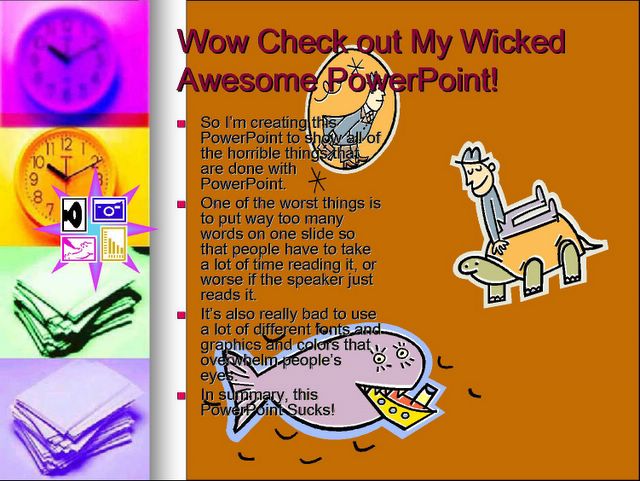
Over at Microsoft's very own PowerPoint blog they point out that wrapping words around an image is just a bad idea. Avoid it, they say. Use a document creator tool, they say. Keep PowerPoint simple, they say.

That's what everyone else has been saying all along. Get rid of the bullet points and the text and focus on communicating visually through the powerful medium that PowerPoint provides. An image with just a few words is all it takes to convey a powerful message.

I know that PowerPoint automatically generates bullet points when you start typing text into the pre-selected text field. I'm sorry. Don't use it. Don't give in. Each slide should, as a general rule, be one, large picture with no more than six words.

The example here is from a recent presentation that I completed. Notice that it says a lot with very few words. I let the image do most of the communication and the words just give a framework for the image to put it into some sort of context.

Even Microsoft understands that PowerPoint should be used more like this and less like this:

Monday, April 18, 2011

Charts and Graphs are Necessary

Where would we be without the wisdom of Stephen Colbert? He helps us understand why charts and graphs are essential to every good speech.


The power of Dr. Martin Luther King Jr.'s speech wouldn't have been as great without his Venn diagram.


Franklin Roosevelt inspired a nation by showing, in bar graph form, the challenges facing the nation.


Thank you Stephen, for setting us straight.

Friday, April 15, 2011

Visualize Doubt

© sframe - Fotolia.com
Doubts aren't the exception for life, they're the rule. If I'm honest with myself I doubt things all the time. I doubt whether my car will start in the morning. I doubt whether I will have enough money to pay my bills. I doubt the Theory of Relativity. I have moments when I doubt the existence of God. In truth I doubt pretty much everything that I don't both fully understand and fully control. The irony is that I'm sure that things that I understand and can control will happen the way I expect and they never do. Even what I'm sure about is open to doubt.

Stan Granberg had a great blog post on the Kairos Church Planting site entitled Preaching in Unbelief.

I propose the best way is to preach the gospel in the context of unbelief. Find your point of unbelief in the text. Hone it to a state of mental "scary sharp," then let God take you to his point of resolution from the text. There it is, the core of your sermon. Now wrap that core with a layer of street made reality and you have a sermon that will grip anybody. Probably even yourself.

It's precisely the point where we stop understanding where we can begin to grow. If we persist in speaking from a position of power, where we have everything figured out and tightly controlled, then we leave no space. Not understanding is frightening. Doubt is exhausting. The typical human response is to avoid, ignore and numb. God calls the leaders in his church to be the first into the breach. We lead the terrifying charge into the face of unbelief so that others can journey with us.

Let your doubt show through as you preach and you'll connect in a much deeper way.

Thursday, April 14, 2011

Vision and Creativity

Vision Green Road Sign Over Clouds
© Andy Dean
When speaking visually you need to be able to put yourself in the place of your audience. Experience your message the way that they would experience your message. Listen with fresh ears. See the connections that they will see.

This might be one of the most difficult things to do in speaking since we have the knowledge. We know what's going on. To look at things anew requires forgetting everything we've spent so much time learning to prepare.

In  Made to Stick: Why Some Ideas Survive and Others Die the Heath brothers talk about the "Curse of Knowledge" which makes it impossible for you to approach a topic from the perspective of a beginner. The curse takes effect when you don't allow your audience to learn along with you. They can't envision what you're saying without all the knowledge that you already have. So when you talk over their heads, they just give up and tune out.

Practice the creativity of joining your audience on the journey of discovery. Learn to experience your vision new each time so that they can follow along with you.

Wednesday, April 13, 2011

Get Lost

© The Blowfish Inc - Fotolia.com
Imagination is a powerful tool. You can get lost in your own imagination. Daydreaming, doodling and pondering; we all have moments where our imagination runs away with us. When you're speaking to people though, you need to find those places where imagination and message coincide.

Instead of describing every detail of a scene for your audience, give them license to imagine the setting. Paint a picture with broad strokes then invite them to step inside with you.

"Paul and Silas were sitting in chains. The prison's bars kept them in but did little to shield them from the elements. The weather beat against them all day and into the night."

So were they hot or cold? Dry or wet? What does your imagination tell you? This is just a simple example of allowing space for imagination. But if we invite people to get lost with us then their minds will connect even more with what we're saying.

When using images, start a story. Don't finish everything, but show the beginning of action or movement. Let people imagine what happens next. If the photo is closely connected to your topic then the imagination will reinforce. But if the image is too tangential then it will distract.

What do you imagine from the picture with this blog? How have you engaged people's imaginations?

Tuesday, April 12, 2011

Fail Well

Failing might be a meme on the internet, but it's also important to being a success in life. Seth Godin points out that failure avoidance is actually working against yourself. If you plan to not fail you are planning to not succeed. For without failure and the subsequent lessons learned, we can't achieve any measure of success.

How can you plan to fail well in your public speaking? First, start by doing risky things. Speak a form that you aren't used to. Practice story telling or joke telling. Speak from a script if you typically use an outline. Use an outline or even no notes. Act out a dramatic scene or talk to the kids (they will let you know if you failed).

Try other things that are outside of your comfort zone. If you're a preacher then join a public speaking club like Toastmasters where you can't talk for half-an-hour about the bible. If you're like me it will challenge you and cause you to fail. Take up a hobby where you learn a new skill then perform that skill in public where there's the high risk of failure.

Learning to fail publicly gives us the confidence to keep trying new things. Experimentation is the only proven road to success, but it's filled with potholes. If you experiment, you will fail. But you stand the chance to learn valuable lessons about yourself and your craft through the process.

How have you failed well? What important lessons have you learned?

Monday, April 11, 2011

Stage Fright

It might seem like a professional public speaker would be over the fears commonly associated with getting up in front of a crowd, but it's not true. The blog of all things helpful, Lifehacker, posted about one way to overcome your fear of public speaking. Essentially you need to psyche yourself up to get ready for getting in front of people. Listen to an energizing song or do some exercise or anything that tends to increase your energy and lift your mood.

I've noticed in preaching that there is a consistent fear of public speaking that manifests in several different ways. One is the podium shield where the preacher stands behind the podium and grips it for dear life throughout the sermon. Another is the ramble-warm-up where there's an extended time of talking about meaningless things to get over the nerves and get to the point of the sermon. There's the scripted sermon that allows the preacher to never have to look at the audience, but instead to just read the words.

One of the casualties of stage fright and the preacher's fear of public speaking is the lack of the use of PowerPoint. I've heard myriad objections to the use of PowerPoint in preaching, but most of them boil down to the fear of the preacher. Learning a new skill and the accompanying risk of failure in a public forum causes the stage fright to kick in before the sermon is written. PowerPoint is avoided because it's different and might be difficult, and above all because it might not work.

What does your stage fright make you do? How do you overcome stage fright?

Photo Credit: Yamil Flores - Fotolia.com

Friday, April 08, 2011

Make things Tangible

The United States Government is shutting down because congress can't agree on a budget for the remainder of 2011. The government shutdown will affect hundreds of thousands of people employed by the Federal institutions.

They are arguing over $37 billion. That sounds like a lot of money. To you and me that's a huge amount of money. But the argument that has shut down the wheels of governing is over less than one percent of the annual budget of $3,818.8 billion.

Less than one percent isn't that much at all. The average salary for an American worker is $42,000, so it would be the equivalent of asking you to lose $400 from your annual spending. That would be $33 a month out of your pocket. You could sponsor a child for less than that.

But the issue is bigger than that. See, the big problem with the budget isn't that we're spending our money in the wrong ways, it's that we're spending money we don't have. Our annual Federal deficit is 43%. That means that our government is spending way more money than it brings in.

So if this were you or me, we would be making $42,000 a year, but spending $74,000 - racking up credit card debt of $31,000 a year. So our friends and family have an intervention to help us get our wildly out of control spending in check. They sit us down and tell us that we can't leave until we write a budget that we can stick to. So we write up our budget for the next month (a month with $2,600 in debt-spending) and we trim $60. Then our friends and family tell us that it has to come from a different place. We can't spend money on popcorn at the movies anymore because that's not healthy. We refuse to budge on the popcorn issue. So none of us go to work the next week. That makes good sense and it's best for everyone involved. Right?

How can you use tangible details to communicate your message.

Thursday, April 07, 2011

Use Details to Connect

I don't connect well with generalities. Neither do you. When President Obama speaks, he doesn't share sweeping statistics as much as he singles out one person in a specific situation to make his point. Remember Joe the Plumber? He became a sensation during the 2008 election because he was "everyman" embodied.

If you want to speak with power and connect with people, then using specific details is important. This is another point that I gleaned from reading Made to Stick: Why Some Ideas Survive and Others Die. It's the details that make the story stick with people. There's a difference between statistics and details, however. I could tell you about the 300 million people in the US, and give you percentages that believe a certain way or act a certain way. But what will make the idea connect with you is if I tell you about my uncle or friend who had a real experience. Cancer is a vague problem until I know someone in chemotherapy who's tired and bald. 


Put a face on your ideas to let your audience visualize what you have to say. 


(Note: I earn a small commission from any books purchased through the link.)

Wednesday, April 06, 2011

Use Emotions to Connect

You might remember the website Save Toby from a few years back where the author posted several pictures of a cute bunny and said that he was broke and out of money. As a result he would have to eat his beloved rabbit if he didn't raise enough money to pay his bills. The donations started pouring in (along with the controversy à la organizations like PETA). The thing about the Save Toby campaign is that no matter how you viewed the website, it was engaging on an emotional level. I saw it as a great joke (humor), some people saw it as a tragedy and gave money (sympathy, pity), others saw it as a travesty and fought to shut down the site (anger).

One of the ways that ideas are sticky, according to  Made to Stick: Why Some Ideas Survive and Others Die, is that they provide an emotional connection. In one sense it doesn't matter much what emotion you use. They all connect people with an idea and get them moving toward action. But emotions will only carry an idea so far. After that something else needs to kick in and get people moving (joy, community, reward, purpose, etc.).

I don't know if you had a similar experience in youth group, but when I was going through there was a strong emphasis on emotional connection. We would spend time thinking about how our sins made Jesus suffer on the cross and even go so far as to nail a piece of paper with our sin written on it to a cross. There were a lot of emotions involved, but the change wasn't lasting because the emotions were mostly negative (guilt, fear, shame) and didn't connect to any positive way to change.

This isn't too far off of the hell-fire and brimstone sermons of a past age. The thought is that if you scare people or make them feel guilty, then they'll do what's right. That might be true, for the short term, but in the long run it won't be a lasting change.

A good presenter uses emotions to connect with people, but uses them wisely.

How do you provide an emotional connection when you speak?

(Note: the book link earns me a small commission on any sales.)

Tuesday, April 05, 2011

Made to Stick, How to Communicate Ideas

When you speak, most of your ideas will fall bounce off of people and disappear from them forever. A very few ideas have what it takes to stick with people. In the book Made to Stick: Why Some Ideas Survive and Others Die Authors and brothers Chip and Dan Heath explore the stickiness of some ideas over others. They start by looking at the incredibly sticky ideas that are urban legends. Urban legends connect on an emotional level with concrete details yet have a twist at the end that really draws us in. They obviously wrote an entire book about how to make ideas stick (and you should read it, it's good stuff), so I won't explain everything they've said so well.

I want to share one of the points that they make that relates to public speaking. Good communication is aware of schemata. A schema (the singular of schemata) is a psychology word used to describe a pattern of thoughts. One of the examples in the book is the schema of a chair. We hold in our thoughts the idea of what a chair ought to be and do, and that can encompass a huge variety from folding metal chairs to plush leather wing-back chairs. Connect your idea to a schema that people are already familiar with and you are letting them do most of your communication. So I can tell you about a rickety wooden chair and you have a fairly clear picture of what I'm talking about. I added two words to the chair-schema and that is sufficient to differentiate one chair from millions of others.

How can you use schemata to communicate more effectively?

(Note: The book link earns me a small commission on any sales)

Monday, April 04, 2011

April Theme - Speaking Visually

No matter how good your PowerPoint slides are, your presentation will only be as good as you are. Everything begins and ends with how you present. If you're a great public speaker, adding PowerPoint slides can connect more people with your message in more ways. But if you skimp on the speaking skills, the slides will do little to bolster a poor talk. So, for the month of April I want to focus on the theme of presentation skills.

Specifically, I want to look at speaking visually. It's important for us to create vivid images with our words so we can connect what we have to say with what's going on in the brains of our audience. Our brains function as primarily visual/spatial processors which means that if you aren't giving people queues to help them visualize what you're saying, then they likely will miss much of what you're attempting to communicate. It's as if our brains are vast art galleries with paintings on the walls and blank canvases stacked up in the corners. You can access a painting that people already have up and link what you have to say to what they already know. You essentially give them a mental post-it note attached to that painting. So now they associate what you said with their previous mental image. If you want to talk about teamwork, you can point to their memory of little league or to a famous team incident so you tag on to what they've already visualized.

Or, you can lead them in painting on a fresh canvas, but we can talk about that more tomorrow.

How do you help people visualize what you say?

Friday, April 01, 2011

Changes in the Next Version of PowerPoint

Over at the PowerPoint blog they've begun announcing some exciting changes that will be rolling out with the first service pack for Office 2010.

You loved it when they rolled out the new, intuitive Ribbon interface known as the Office Fluent User Interface. And the upcoming changes will be no different. The PowerPoint team has heard the cries, or rather snores, from conference rooms the world over. It may have taken eight long years for them to heed the call of Edward Tufte that "PowerPoint is Evil" but they've finally done it.

With the next version of PowerPoint, bullet points will be disabled by default. Not only that, but no more than six words will be permitted on any slide in the standard template, making Seth Godin cheer. Finally, when you create a presentation you won't be able to include more than ten slides at a time and if PowerPoint detects that it's in presentation mode for longer than 20 minutes it will shut off automatically in order to follow Guy Kawasaki's 10/20/30 rule.

Finally the makers of PowerPoint are doing something to combat the rampant plague, Death by PowerPoint.

Thursday, March 31, 2011

More is not Always Better

In reflecting on the amount of media that we have available, Seth Godin said that: "More media is not always better."

But more is the American way, right? We're supposed to have more money, more stuff, more power, more food, more, more, more. It's the core of who we are and what we strive after.

Sometimes I think that the American dream invades our churches. Pshh, "sometimes" I think that? I'm growing more and more convinced that our churches are drowning in a sea of "more." We're constantly looking for more people, more ministries, more donations, more conversions. Our country is afflicted with a disease and our churches are doing nothing to help. In fact, our churches often pull people deeper into the sickness.

The problem is not the church that Jesus started, but rather the way that we've come to interpret his church. We've become so enamored with being relevant to our culture that we succumb. We are conformed to the pattern of this world (Rom. 12.2) so we've lost our ability to speak a transformational word. When the divorce rate, the abortion rate, the adultery rate, the drug abuse rate, the murder rate and just about every other statistical measurement of brokenness reads the same for those in the church and those outside the church, there's something wrong. If the church isn't different than our culture then we don't have anything to offer our culture.

Our world cries out for more and the church echoes the hungry cry. It's time for use to stop. It's time for us to be transformed. Our leader and founder, Jesus was a homeless middle-eastern man who relied on the hospitality of others. What if our churches relied on the hospitality of others? What if we didn't always come in to save people with our fat wallets? What if, sometimes, we needed saving? What if we told people to take their donations for one Sunday, just one, and bless their neighborhoods instead of giving to the church? What if?

How do you think we could give up the need for more?

Wednesday, March 30, 2011

What is the Internet

Just 17 years ago most people didn't know what the internet was. Today it defines most of what we do on a daily basis. Bryant Gumbel "wasn't prepared to translate" the email address he saw, which clues us in to something important: electronic media is a different language. It takes translation for those not already fluent.

How can you translate electronic media for those who don't speak the language?

Tuesday, March 29, 2011

Resize Pictures with Fotosizer

My friend Matt pointed to this neat program a couple months ago. It's called Fotosizer and it gives you the ability to quickly resize or recolor a group or folder of images.

Select the images you want to change and then the changes you want to make. Click "Start" and it'll get going while you go get a cup of coffee. Pretty slick indeed.

What software saves you time and effort when editing pictures?

Monday, March 28, 2011

High Contrast Photo Magic

Lifehacker points out a simple trick for achieving high contrast photographic magic. Essentially you make a copy of the Green color channel then overlay that on the original picture. Make it slightly transparent  and you'll get an effect that ups the detail and contrast at the same time. Check out a step-by-step in the video below.

What color channel wizardry do you rely on?


Note: In Paint.NET you'll find this under the "Adjustments" menu then "Color Accent." Make "Duplicate" layer then select the top layer and open the "Color Accent" tool. Crank "Green" to 100 and click "OK." Then click the "Properties" button for the layer and set it to "Overlay" and slide the transparency to about 50%.

Friday, March 25, 2011

Photo Editing Basics: Effects Plugins

Both Paint.NET and Photoshop are super powerful tools for photo editing, partly because there is a seemingly limitless supply of effects that you can use on your pictures. Most of the basic effects are built into the software so you can play with blurring, sharpening or adding lighting effects to any image. But for some of the more specialized effect you might need to find and download the effect as a plugin to your photo editing software.

You can grab Pain.NET plugins here as either a package or individually. Once you've downloaded the plugin you need to install it into Paint.NET (hey, here's a handy tutorial). The simple explanation is that you will extract the contents of the ZIP file to the Extensions folder of your Paint.NET directory.

Photoshop, as a paid program, has a bit more polish to its plugin process. But with that you'll pay for most of the plugins, anywhere from a few bucks to hundreds of dollars. You can browse through the available options at the Adobe Marketplace.

In my experience, Paint.NET needs to have several plugins installed before it has all the features of the stock version of Photoshop, and some of the features of Photoshop may not be available at this point in Paint.NET. However the open source nature of Paint.NET means that developers all over the world are crafting plugins that you can add to your experience for zero monies, versus having to pay for everything in Photoshop.

What's your preference?